


Rhinoplasty in Cologne: open and closed techniques, procedure, healing process, risks, and costs explained in an easy-to-understand way. Request a consultation now.
CURRENT:
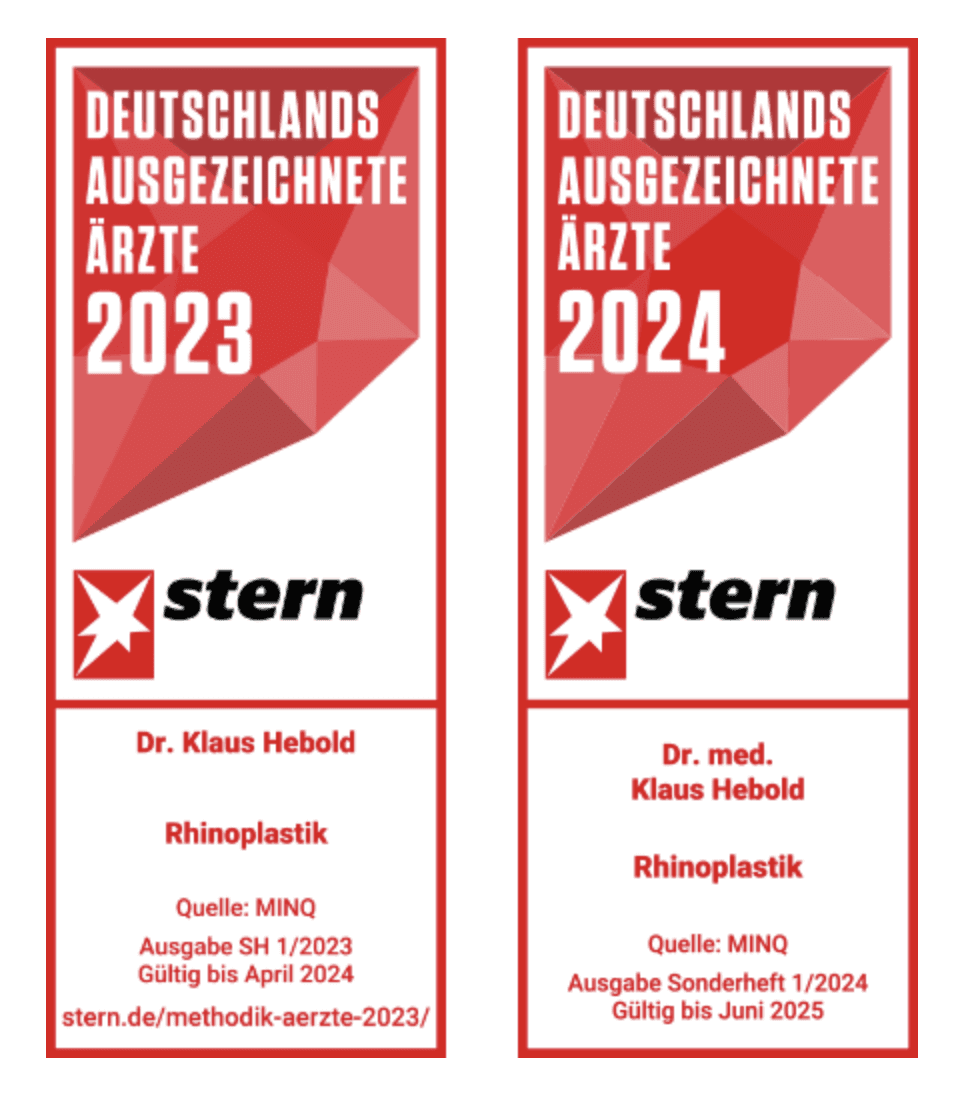
Dr. Hebold has been awarded in 2025, as well as in 2024 and 2023, along with 20 other nasal surgeons in Germany, in a research-based physician recommendation list of the weekly magazine "STERN" once again for his expertise in "Rhinoplasty" . For this award, we did not apply nor did we use financial resources. After the special issue appeared, we acquired the right to use the seal. Dr. Hebold exclusively covers nasal surgery at the Forum Clinic.
He will be exclusively focused on nasal surgery at the Forum Clinic starting from July 1, 2025.
The most important facts
Operation Duration: approx. 2–4 hours
Anesthesia: General anesthesia
Splint/Tape: 7–10 days splint, tape if necessary for another 1–2 weeks
Please request nose surgery with Dr. Hebold by phone or email
Nose surgery is exclusively in the hands of Dr. Hebold. Appointments for this can only be made by telephone or email – online booking via Arzt-Direkt is not possible for this treatment.
The aesthetic nose surgeries and corrections for women are the focus of the Forum Clinic in Cologne.
On its own, nose surgery is the most common major procedure at the Forum Clinic. No other area of plastic surgery has seen as much progress in recent years as aesthetic nose surgery! We have a keen sense of the aesthetics of the female nose. We no longer offer nose surgeries for men.
In our FAQ about nose surgery, we have compiled answers to frequently asked questions in our clinic.
The surgical techniques are fundamentally different today than they were 15 years ago, that…
It seems a new era of nasal surgery has begun (more on this below). The surgical techniques are significantly gentler and more precise, and the results have become much more predictable and manageable. No year goes by without further improvements and refinements being introduced. The topic of nasal surgery excites us. Nasal surgery is also the area of plastic surgery in which the aesthetic-artistic aspect is most demanding and where, in addition to knowledge, experience, and skill, particularly talent is required. In no other area of plastic surgery does the statement hold more true than in nasal surgery that anyone who wants to be truly excellent must not pursue this field on the side. "All or nothing" is the motto here. We "burn" for noses!
initial consultation
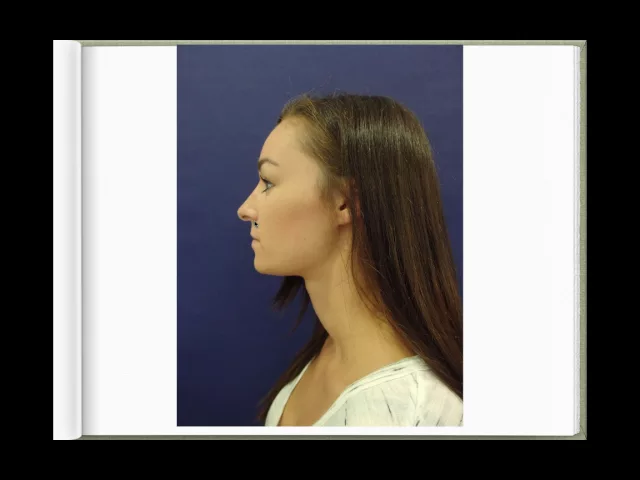
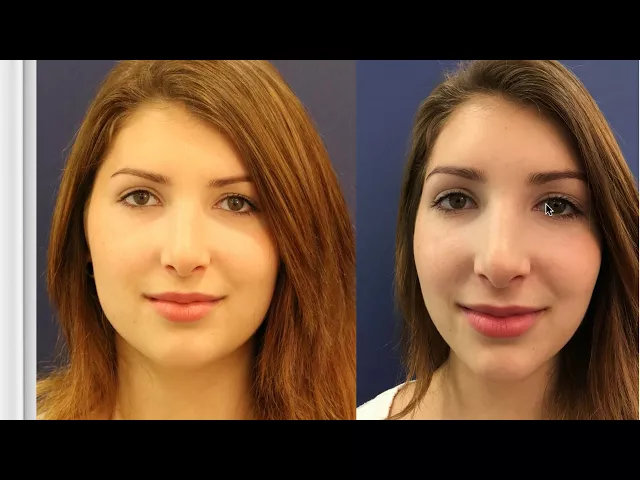
During the initial consultation in our clinic in Cologne, we examine your nose from the outside and inside and advise you on the possibilities. At this appointment, a computer simulation of the nose will be created together with you. The computer simulation has proven to be extremely effective. It allows for a clear assessment of whether the desired nose correction harmonizes with the other facial proportions in the altered image. Together, we develop a vision of the future nose shape. The computer simulation helps to check if your expectations align with ours. It is not an absolute guarantee that after a procedure the nose will look exactly like this. However, the concordance rate is very high, and the computer simulation has become a very valuable planning tool. Even though deviations between the result and the planning can never be completely ruled out, it is nonetheless essential for a well-thought-out treatment concept to have a clear goal! We allow all our patients to take a picture of the computer simulation home to discuss the developed vision with friends and family. Furthermore, you will have the opportunity to see the results of our work - from simple hump noses to aesthetically complicated and repeatedly operated and reconstructed noses. The doctor and the patient must trust each other, and it needs to fit. What sounds so banal implies that both (doctor and patient) must decide whether they want to walk the path together. It is also related to individual aesthetic perception. It is much easier to securely achieve a beautiful goal when you as a patient and we have the same vision of beauty. The conversations (at least two) usually quickly reveal whether it "fits." However, it is also essential to clearly outline the limits of what is possible during the simulation. Some patients come with pictures of stars and dream of a small and delicate nose. When in reality the nose is large and long with coarse pores and thick skin, this wish cannot be fulfilled. The skin is the limiting factor; it is so incredibly important that we have even made a separate video on this topic (see below). However, there are also times when we do not want to operate for whatever reasons. We try to convey this very sensitively, either advising completely against it or recommending alternatives or second opinions.
The simulation
The simulation, as described above, takes place during the first conversation.
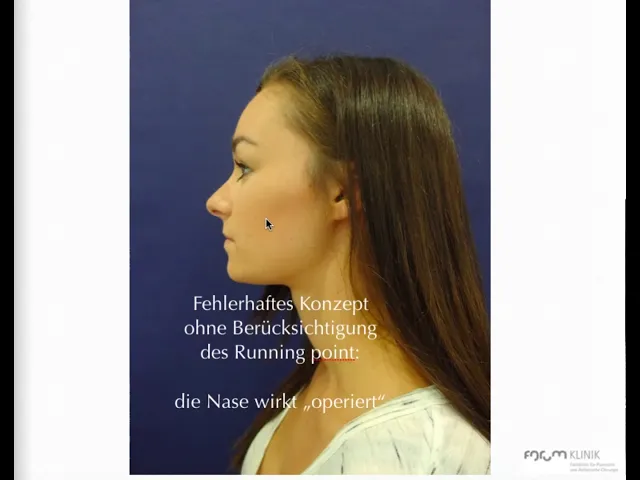
To give you a sense of how we approach the simulation, we have created two small youtube videos on this topic. In the first video, you will see what is important to us in a simulation. In the second video, we explain the possibilities and limitations: the major topic in nasal surgery is the skin. There are patients with particularly thin, normal, and very thick skin. Accurately assessing this is our task during the first conversation. The simulation depends on the texture of your skin. With very thick skin, the limits of alterability are narrower than with normal skin. However, significant improvements are often still possible despite problematic skin because we perceive proportions more than absolute values. The second video impressively shows you this.
After the first conversation
After the first conversation, during which we discuss opportunities and risks, we will meet a second time before the operation. This time, it will be more about the actual surgical planning, information, photo documentation, and the anesthesia discussion.
The operation day
On the day of the surgery, you will briefly speak with the surgeon once again before the operation. The purpose of this conversation is the surgeon's "briefing". Every nose is unique and requires an individual approach. This conversation should recap what was discussed in both prior meetings and be fresh in the surgeon’s memory, who will then focus solely on your nose until the end of the surgery. The surgery begins with anesthesia. Once you are asleep, the surgeon injects the skin and mucosa of the nose with medications that reduce blood flow and locally numb the nerves for approximately 3 hours. This allows the procedure to be performed under practically blood-free surgical conditions. Since the nose is numbed, the anesthesia can be superficial and gentle. Additionally, the subconscious essentially "doesn't notice" anything. A medication applied inside the nose has a side effect of mild euphoria, so after the operation, patients may seem surprisingly cheerful to their loved ones. However, by the next day, none of that is felt anymore. An operated nose usually causes little to no pain!
The operation
The operation of the nose is usually performed at the Forum Clinic in Cologne as a so-called open correction. The only seam, which is often not visible later, is at the nasal bridge; the remaining stitches are self-dissolving and inside the nose. The open method gives us all the possibilities to work precisely under visibility and allows us to draw on an almost infinite variety of options to influence the later shape of the nose precisely, something that was not possible with closed corrections before. At this point, we could insert entire books that deal with the surgical techniques. It is self-evident that this is not sensible, as laypersons can hardly grasp the differences without years of their own experience in surgery. Nevertheless, there is a certain need for information regarding trends. As a patient, you also want to be sure that your practitioners are up to date. In general, it is worth mentioning at this point that the essential trend in modern nose surgery is increasingly moving towards respectful - preserving - surgical techniques. This concerns not only the bony structures but also the cartilaginous structures. A topic that is currently being intensely discussed among experts is "preservation rhinoplasty," that is, "preserving nasal surgery." This refers to a technique in which the entire nasal bridge is lowered as a block without being broken down into its individual elements. That this technique is not a universal technique that works well for every nose is understood. We are also working on technical refinements for the internal cartilaginous structures that are intended to ensure aesthetic improvement while maintaining or at least preserving functionality.
Ultrasound surgery: this term is often used in a marketing context on the pages of some competitors. Of course, we use ultrasound surgical instruments - the piezotome - since it became available on the market. It is an excellent instrument for precise work on the bone. What it is not, is a standalone "technique." To put it bluntly: if someone is not skilled, the piezo won't help them. However, it helps very well to work atraumatically and precisely in hard-to-reach areas.
The after-treatment – no tampons!
The aftercare is performed with a splint, depending on what has been done. The splint remains in place for about 7 days. A prerequisite for splint aftercare is a surgical technique that leaves very stable conditions of the bone scaffold at the end of the surgery. This is also a progress: the healing time is shortened, and control over the outcome is improved. We do not use tampons to stuff the nose. For procedures on the nasal septum, we use a soft silicone film as internal splinting (so-called Doyle splints in the soft version). With these splints, you can breathe air through the nose directly after the surgery, but you cannot smell, or it is limited, as the air is redirected to the throat while the splints are in place. The first week after surgery, the nose is equipped with the mentioned external aluminum splint. During this time, you have no chance to assess the appearance of your nose. In profile, your nose appears too steep in the first week. This is due to the internal silicone films and the swelling in the area of the nasal base. After a week, the splint and splints are removed, and your nose can be assessed - not as a final condition, as that takes one to two years, but at least good enough for an assessment. Almost always, the moment of splint removal is a beautiful moment.
rail distance
After the removal of the splints, you can already see a lot, especially the profile. From the front, the nose may still appear swollen at first. Depending on skin type and the type of nasal surgery, the swelling subsides at different rates. It can take up to two years for the last operation-related swelling to disappear, especially in the area of the nasal tip. By the time of the splint removal, you should already be much more satisfied with the new nose after a nose correction than with the old one. Even beyond a year, minimal changes occur that gradually transition into the natural aging process. Sometimes, however, minor irregularities may only become apparent after complete swelling has subsided, or there may be minimal but bothersome bone regeneration. These are reasons to wait a year for the final assessment. Even though the nose usually becomes more delicate in the second year, we meet for evaluation after 10-12 months. A follow-up assessment takes place after 4 weeks on-site or - more frequently now - via photo or video.
Very important: only the unity of form and function leads to a good result. This means that we must dedicate ourselves with the same commitment to functional improvement as we do to aesthetic enhancement. At the Forum Clinic in Cologne, we offer the complete range of nasal surgery, including corrections of the nasal septum and turbinate procedures. For nasal septum corrections, we offer all technical possibilities, including extracorporeal correction (correction outside the body and re-implantation for particularly severe cases). Nasal septum perforations (holes in the nasal septum) are also certainly addressed.
For previously operated patients, the procedures are technically more demanding and difficult. It is important to carefully choose the timing of a well-planned correction. As a rule, at least a year should have passed since the previous surgery. Then, even with severe previous conditions, a very nice result can usually be achieved. Often these corrections require additional measures such as cartilage transplants from the back of the ear.
Revisions
Revisions refer to corrections for one's own patients. Corrections for others' patients are called "secondary" corrections. Revisions occur everywhere, including with us. In a good and specialized department, they are not a sign of faulty or poor surgical technique but rather a consequence of healing processes that are not entirely under the control of the operator. In good clinics, revisions are mostly minor procedures that can often be performed in a closed manner. This means that the incision on the nose bridge does not need to be reopened. Most patients for whom a revision is planned are fundamentally satisfied with the result but wish for improvements at one point or another. An example is a small irregularity on the nasal dorsum after a hump nose, which only develops during the healing process due to bone regeneration. In this respect, a revision can more accurately be seen as an opportunity to further improve a result. The likelihood of seeing such an opportunity for further improvement during an evaluation after one year is about 20%. Some large international statistics even speak of 30%. At the Forum Clinic, revisions are completely free of charge.
Secondary nasal surgeries
Secondary nasal surgeries are procedures following a failed initial surgery by another previous surgeon. Unlike revisions, the outcome is often not fundamentally satisfactory and requires only fine adjustments, but is so severely deformed that trust in the previous surgeon has been lost and another surgeon is entrusted with the repair. These procedures are considerably more difficult than procedures on unoperated noses or fine corrections on well-operated noses. They often require cartilage transplants, for example, from the ear or rib. The good news is that a wide range of options is available for these patients to reconstruct aesthetically pleasing noses from sometimes catastrophic conditions with love and dedication. It is often crucial not to choose the easy, small path during the revision, but rather the strategy that has the highest probability of achieving a good outcome, even if the effort is greater. Particularly in the case of multiple prior surgeries, it may also be the case that despite all love, effort, experience, care, and talent, perfection may not be achieved, but rather just damage limitation can be accomplished. Each subsequent surgery is more difficult than the previous one, as the tissue becomes increasingly scarred, less vascularized, and the healing processes more unpredictable.
What is new in nasal surgery?
Without a doubt, the radical decision to operate on almost all noses "open" is the true revolution that has set everything else in motion. The USA and France were the pioneers. The days of discussing the pros and cons of open and closed techniques at congresses are over. The naming of the possibly most significant European congress for nasal surgery is now very impressive: "Bergamo open rhinoplasty congress ". The open technique: once a possibility, now a prerequisite.
Open technique means that the surgeon does not operate as before through several incisions inside the nose without (or only with extremely limited) visibility of what they are doing, more by feel than visual control. Today, the nose is opened with incisions inside the nostrils and these are connected by a 3mm long angled incision at the bridge of the nose so that the skin of the nose can be completely lifted: voila, everything is exposed and visible, and now you see the surprises! Cartilage that was thought to be innocent and straight is suddenly bent, asymmetrical, often crooked and askew, and one wonders what all could have been overlooked, as the root of failure lies in not recognizing. Being able to see also means being able to correct and must. The open technique leaves nothing to chance.
Interestingly, the introduction of the open technique in Germany was a kind of war of faith. We still have a phrase ringing in our ears that I had to hear from a very esteemed but often very inflexible and radical colleague in 1994: "If you operate on such a nose openly, you are making a treatment error!" 15 years later, we heard the same sentence again from the same colleague at the same place; he had only replaced the word "open" with "closed".
Open is easier. The statement is true and yet not. Of course, it is easier to do things under vision that had to be done without sight before, but much more is also possible. The range of possibilities has grown enormously and is constantly continuing to grow. And the demands of specialized nasal surgeons are also increasing. Results that satisfied us 15 years ago embarrass us today. The bar is set higher and higher.
Through atraumatic (less damaging) surgical technique, noses today swell less quickly, facial swelling and bruising are reduced, recovery time is shortened, comfort is improved, and the outcome is more secure than in previous years. Yet, despite all improved possibilities and all dedication, there is not 100 percent control. About 20-30% of all nose surgeries worldwide undergo a revision after one year. Often this is just a small issue and does not require a complete re-correction. Surgeons who claim not to have corrections do not take their patients seriously and brush them off. This is unfair. When a patient gives a doctor their trust, it is, independent of financial matters, a great honor. In return, it is actually also a matter of course to do everything to be worthy of this trust. It is unworthy to declare what is not considered beautiful as beautiful. Thus, it is even more important to reconcile aesthetic ideals before the operation! Corrections are a matter of honor for us and are free of charge (with the exception of secondary noses, see above).
"Preservation Technique"
The new "Preservation Technique" is very en vogue. The basic idea is to preserve certain anatomical structures completely unchanged while still altering the profile of the nose. Unfortunately, we have seen many victims of the new technique for secondary correction. We believe that the technical innovation has its justification, but it is not suitable for every nose. Like all technical innovations, it must show over time what value it will have. It is certainly wrong to operate on all noses using the Preservation Technique, but it is also wrong to completely shut oneself off from it. In our surgical concept, the element of preservation increasingly flows in. In the area of the alar cartilage, whose instability after an operation often leads to a ventilation disorder, we have developed a technique that preserves stability while still changing the shape as desired.
We would be happy to explain to you in detail the various options for a nasal correction in a conversation. We look forward to welcoming you to the Forum Clinic in Cologne.
The simulation of aesthetic change
As part of the initial consultation, we create a simulation of the desired change on the computer. The purpose of the simulation is multifaceted:
1. The simulation helps us recognize the meaningful and necessary changes. Successful and aesthetically pleasing results are those that are proportionate and fit the respective face. On the computer, we can check what is needed to achieve the optimal aesthetic proportions. It is important that we remain realistic in the simulation and foresee whether the skin of the nose will accommodate the change.
2. The simulation helps you to get an idea of a possible outcome. It is not a guarantee that the nose will look exactly the same; however, it is a shared goal vision. If there is no agreement on the goal, one should not embark on the journey together.
3. The simulation gives us the opportunity to assess whether your expectations are realistic.
At the end of the simulation, you have the opportunity to take a photo of the simulated result with a smartphone or camera so you can view it at home in peace.
Tampons?
Time and again we are asked whether tampons are used. We do not use tampons. For procedures on the nasal septum, we use so-called Doyle splints, which are soft silicone sheets for stabilization. You will still be able to breathe through your nose despite the sheets.
The course of the surgery
Preparation: no blood-thinning medications for 14 days
Surgery: under anesthesia, approximately 2 hours, outpatient or inpatient, usually only one overnight stay required
Aftercare, removal of splints and stitches after about 10 days, removal of the Doyle splits often earlier.
Otriven gel in the first week, then nasal ointment 2 times daily. Sea salt spray as often as desired. Sniffing is good, blowing your nose is bad.
After splint removal, night "taping" of the nose with a special tape that we will provide to you. Duration variable according to agreement.
Follow-up checks after splint removal at 6 weeks, 3 months, one year, and two years recommended.
Social capability: with cast after one week, without after 10 - 12 days.
Incapacity for work: usually 1 - 2 weeks.
Start sports and sauna cautiously after 4-6 weeks
Avoid glasses for 6 weeks. If not possible, we will model a splint that allows you to wear glasses.
After the surgery
Whenever surgery is performed on the nasal septum - even when we need the posterior parts of the nasal septum as cartilage donors - we treat with silicone sheets with attached ventilation tubes. We never use tampons! You will have good airflow from the start through the ventilation tubes. In the first few days, it is important to keep the "tubes" clear by consistently lifting and using saline spray. If this is not achieved, it is not a drama, but it will be uncomfortable because you will not get as much air through your nose until the sheets are removed. The sheets are removed after 1-7 days, depending on what we have done. Many patients are afraid of the removal of the silicone sheets because they have heard horror stories about removing tampons. They do not need to worry! Silicone sheets are not tampons, and in skilled, caring hands, removing the sheets does not hurt. Silicone never sticks, even after weeks, and always comes out gently.
After removing the sheets, nasal care consists of: saline spray as often as comfortable and 1-2 times a day ointment, e.g., Bepanthen. If the nose starts to "block", you can use Otriven nasal gel in the first week (which you will receive from us). Please do not use it for longer than a week as it can become addictive.
After about 8 days, the aluminum splint on the bridge of the nose is removed, and the stitches on the nasal tip are pulled. This is the first moment of truth. Although there is still swelling, the shape can be recognized. In particular, the tip of the nose is still swollen. After the removal of the aluminum splint, we immediately tape the nose with skin-colored strips that are hardly noticeable and that you will wear for a few more days. After that, you can apply makeup to your nose during the day and tape it at night in the first weeks and months; we will show you how and provide the tape (transparent, from 3M). It helps to accelerate the reduction of swelling.
Within the first 6-12 weeks, some patients may notice that their nose looks slightly different every day. There may also be a phase where slight asymmetries occur, which will disappear over time. Stay calm: in the end, everything will be fine, and if not everything is fine, it is not the end. After a year, most things are settled; small changes toward a delicate and slender appearance may still occur in the second year.
RISKS
Time and again we are asked whether tampons are used. We do not use tampons. For procedures on the nasal septum, we use so-called Doyle splints, which are soft silicone sheets for stabilization. You will still be able to breathe through your nose despite the sheets.
Caution selfies!
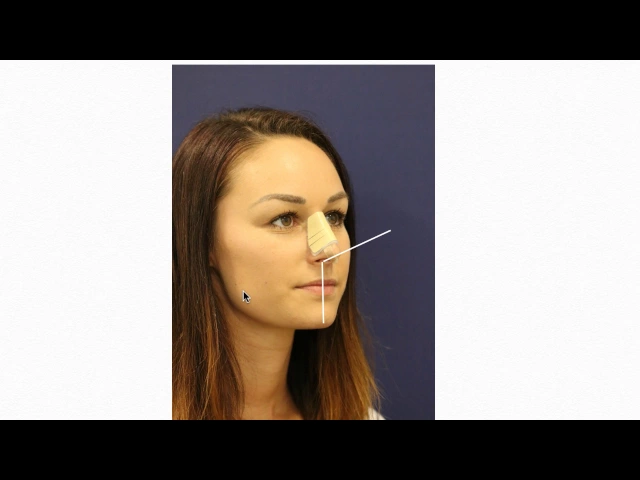
Selfies (self-made pictures taken with a mobile phone and outstretched arm) distort and enlarge the center of the image. What is in the center of the selfie? Correct: the nose! Always take pictures of the nose from a greater distance and with a telephoto lens. Please see the video of a professional photographer for this. In typical shots taken with a mobile phone, the nose is not accurately represented.
When do we not operate?
We usually conduct two consultations with you before the nose surgery, and in individual cases, even more. During this process, we assess, to ensure your safety and ours, based on our best knowledge and conscience with a lot of clinical experience, whether it makes sense to offer you an aesthetic surgery on your nose. If not, we advise against it and possibly refer you to alternative contacts where you would be in good hands for a second opinion.
Costs
You will receive a detailed cost plan for the intended procedure after the first consultation. We distinguish between costs incurred for an aesthetic service and costs that arise from the resolution of a medical problem.
Costs for an aesthetic correction must be borne privately by you.
Costs for medically necessary measures are covered by health insurance companies. With statutory health insurance, we can bill directly and are authorized to assess the findings ourselves. Patients with public insurance do not have to submit any applications. Patients with private insurance should obtain approval from the health insurance company in advance of surgery with the estimate for the medical part.
Important: if a medical problem and an aesthetic service are provided in one procedure, it is not the case that the insurance will cover an aesthetically motivated part! Anesthesia costs will also be billed separately. Therefore, it is not true that in the presence of a medical problem and an aesthetic desire, the latter can be treated at a lower cost.
Attachment:
Causes of nasal ventilation disorders and post-treatment tips, keyword nasal irrigation
Ventilation disorders of the nose can be simply expressed as having three causes:
Anatomical
Non-anatomical
Medication-related
Anatomical Causes
can be divided into two groups:
Obstructions
Instabilities
Obstructions
can include a severely deviated and space-reducing nasal septum or abnormally enlarged turbinates. Both can occur, but are often "overdiagnosed." Not every deviation and bending affects the function. The fact that this diagnosis is often made too frequently explains therapy failures. The treatment of a genuine ventilation disorder caused by obstruction is surgical and, when indicated, often successful.
Instabilities
can be simply described as insufficiently stable conditions in the area of the cartilage-based nasal entrance and the internal nasal valve. This diagnosis is certainly made too rarely. Stabilizing interventions can provide relief.
Non-anatomical Causes
can also be categorized into two groups:
Allergic
Non-allergic (functional)
Medication-related
A) Allergic Causes
Hay fever is one of the most common, followed by dust allergies, etc. In addition to local treatment with corticosteroid nasal sprays, treatments for the underlying allergy, desensitization, etc., are considered. Changing the mattress to get rid of the millions of dust mites in the old mattress is sometimes a good idea.
B) Non-allergic (functional) Causes
If an anatomical cause and an allergic cause are excluded, it may be a functional breathing obstruction. Patients complain of tendencies to swell in their nose, often exacerbated at night. It is normal for us to alternate between a nostril from which we can breathe better. It is not normal for one nostril to be completely "blocked". These complaints are intensified in winter with dry air.
Air humidifiers in the bedroom, properly maintained, can be useful. For the treatment of the disorder in the nose, we recommend the following concept:
A radical, absolute, and unconditional avoidance of so-called "nasal drops." This refers to nasal drops - or ointments - that contain decongestant medications.
Corticosteroid nasal spray over a manageable period of several weeks
Hypertonic nasal rinses: here you rinse the nose, so to speak, with seawater with about 3.5% salt content. If you do not live by the sea, use clean water and mix 35 grams of salt into one liter of water. These rinses work wonders: after that, the nose runs a bit and is moist: that is exactly what your nasal mucosa needs and what it lacks in winter with dry heated air. Think of dogs: they often have a moist nose that works perfectly! If your nose runs too much, rinse again, this time with isotonic saline solution, i.e. 9 grams of salt in one liter of clean water. You can use commercially available nasal douche devices or make it even simpler: wash your hands and form a bowl with one hand, pour the saline solution into it, lean over with your nose to the hand, and "sniff up," then let it flow out again. If you do it carefully, it works perfectly. A tip on the side: you can estimate the salt content. Taste the solution: isotonic saltwater with 9 grams per liter is as salty as tears, hypertonic salt solution is as salty as seawater (Atlantic or Mediterranean, not Dead Sea and not the Baltic Sea). A few grams make no difference.
C) Medication-related Causes
A number of medications can lead to swelling in the nose. THE main culprits, however, are precisely the "nasal drops," which are taken by people with ventilation disorders in the hope of being able to breathe better. The medical term for the dependencies that arise here, similar to addiction, is "privinism." Throw away the nasal drops, they harm your sensitive mucosa. For weaning, a corticosteroid nasal spray and hypertonic rinses are suitable, as mentioned above. The dependency on nasal drops leads to the mucosa regressing (atrophying), the tendency to swell increases without medication, and you can practically no longer breathe freely without drops. In extreme cases, the nose can be severely damaged.
FAQ
Before the surgery
Course of the operation
After the surgery
Wonderful care after the surgery
Dealing with the wound after the surgery
Dangers during the surgery
Cost of the surgery
Please request nose surgery with Dr. Hebold by phone or email
Nose surgery is exclusively in the hands of Dr. Hebold. Appointments for this can only be made by telephone or email – online booking via Arzt-Direkt is not possible for this treatment.


