Breast Augmentation Cologne: Methods, Procedure & Costs | FORUM Klinik
Breast augmentation with implants or autologous fat – endoscopically on request, without scars on the breast. Methods, procedure, risks, and costs. FORUM Klinik Köln.
Breast Augmentation – Treatment Overview




The most important facts

Operation Duration: approximately 60–120 minutes. Anesthesia: general anesthesia


Support Bra: 6 Weeks

Suitable if...
If you wish for a fuller, more feminine bust and a harmonious décolleté.
If you want to compensate for volume loss after pregnancy or weight loss.
If you want to harmonize asymmetries or unique shapes (e.g., naturally small/tuberous breasts).
If you desire natural, body-fitting results and have realistic expectations.
Which type of implant is right for me?
Every breast is unique. To ensure that shape and feel match your figure and daily life, different implant shapes, sizes, and firmness levels are available.
Round implants create a well-shaped décolleté with even volume.
Anatomical (teardrop-shaped) breast implants are modeled after the natural shape of the female breast.
Depending on the starting position and goals, we will choose the appropriate method together.

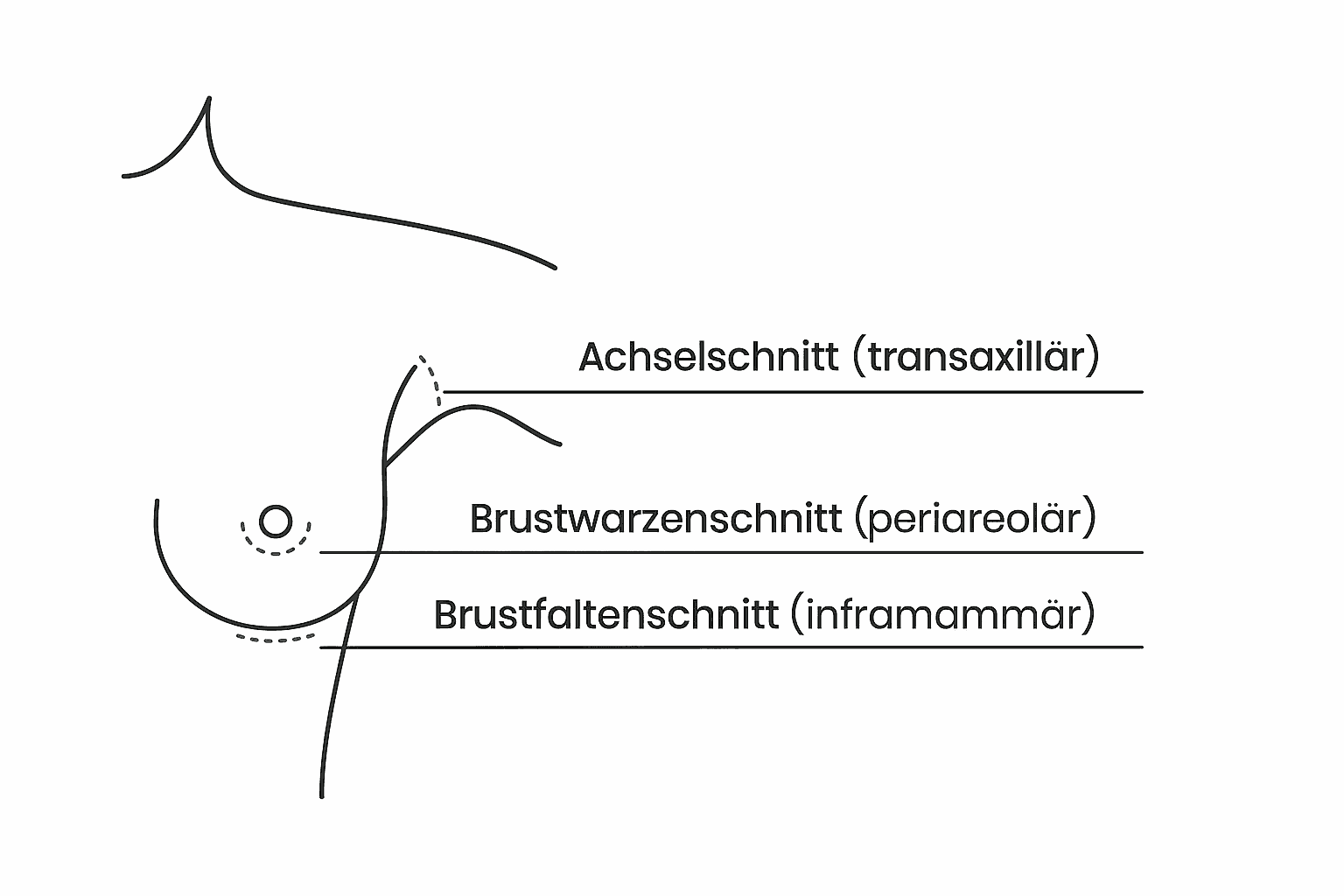
The cutting guide
Various incision types are available for breast augmentation. Which method makes sense depends on your anatomy, the tissue situation, and your goals. We will discuss this in a personal consultation – calm, transparent, and tailored to your wishes.
Axillary incision (transaxillary): Access via the armpit, the breast remains scar-free visible; often endoscopic, suitable for appropriate anatomy and desire for discreet scars.
Areola incision (periareolar): Cut at the edge of the areola, the scar can recede in the natural color transition; advisable in selected findings.
Inframammary incision (inframammary): Cut in the inframammary fold with very good visibility and control of implant placement; the scar lies inconspicuously in the fold.
Implant location
Basically, breast implants can be positioned either over or under the breast muscle; the subfascial position serves as an intermediate solution.
Above the muscle (subglandular): Shorter recovery time, emphasizes the upper pole; suitable when there is sufficient glandular/fat tissue and good skin quality.
Under the muscle / Dual-Plane (submuscular): More tissue coverage over the implant, soft transitions, and reduced edge visibility; sensible when there is little own tissue or a discreet, natural target appearance (initially some muscle-related tension pain may occur).
Under the muscle sheath (subfascial): Intermediate position under the fascia of the breast muscle; connects aspects of both variants and is selectively applied.
In the personal consultation, we calmly explain the advantages and disadvantages and transparently recommend the implant position that best suits your goals and anatomy.


The endoscopic breast augmentation – A special procedure of the Forum Clinic
Precise, gentle, almost invisible scar: Through a fine incision in the armpit, we create an exact pocket under the large pectoral muscle under endoscopic view and place the implant without contact.
Suitable if…
you desire a breast augmentation without a visible scar on the breast.
You prefer a precisely shaped, naturally appearing result with submuscular positioning.
You primarily want enlargement or plan a gentle correction after a previous surgery.
Relatively unsuitable …
in cases of significantly sagging breasts, when no lifting is planned (often an additional breast lift is sensible then).
after previous surgeries in the armpit or if the implants cannot be safely placed under the muscle (we clarify this on a case-by-case basis).
Process – 4 Steps
Preliminary Consultation
In the personal consultation, we will address your individual wishes, concerns, and questions and find the appropriate solution for your issue. We will discuss implant vs. autologous fat vs. endoscopic technique, examine anatomy, skin quality, and proportions, clarify realistic goals, risks, and healing processes, and document everything transparently (including photo documentation and information).
Preparation
You will receive clear, written preparation guidelines (medications, nicotine/alcohol, possibly imaging/laboratory). We will finalize the size/profile/position of the implant or donor areas for autologous fat, agree on access and surgical plan, schedule the procedure, and explain the process on treatment day – including arrival and departure as well as a companion.
Treatment/Surgery
The surgery is performed under appropriate anesthesia. Depending on the method, the implant is positioned precisely (e.g., dual-plane), or processed autologous fat is introduced in defined layers; with endoscopic technique, access is made via the armpit. We work tissue-friendly and according to standardized safety protocols. Subsequently, a support bra/bandage is used.
First Aftercare
After the recovery phase, you will receive pain management, wearing instructions (bra/compression), and behavioral recommendations for the first days. Follow-up appointments (wound check, suture removal, progress check) will be scheduled; physical rest and gradual increase in activity will be explained. You can be reached at any time through a clear emergency route.

Possible risks
There is a risk of BIA-ALCL "Breast Implant Associated Anaplastic Large Cell Lymphoma", a rare form of non-Hodgkin lymphoma associated with the presence of breast implants. Globally, around 630 confirmed cases have been published, 11 of which are in Germany. According to current knowledge, the surface texture of implants plays a central role regarding the risk of developing BIA-ALCL. Macro-textured implants, meaning those with a very rough surface, seem to carry an increased risk. We have transitioned primarily to using implants with micro- or nano-textured surfaces, as these are described as having a significantly lower risk. For the selection of breast implants, we have currently preferred the manufacturer Motiva. The decision was based on the fact that the manufacturers participate in studies presented to the American regulatory authority FDA (where significantly stricter quality controls are conducted than in the EU approval process) and meet our high quality standards. In specific cases, implants from Polytech are also utilized.

Implants from Motiva
Here, we are particularly convinced by the implants, which feature an ergonomic gel - MOTIVA ERGONOMIX. This is a real advancement, as the implants are round or mirror-symmetrical in structure, but under the influence of gravity, they anatomically change: the gel follows gravity, contributing to a more natural appearance. The trick is that these implants have the advantages of anatomical implants, but with a significantly lower risk of ALCL and no risk that rotation in the body will ruin the result. Additionally, the required incision is even smaller.
For all implants, we apply the "No cotton - no touch" technique: The entire procedure is carried out without the use of cotton-containing compresses or cloths to avoid any contamination with cotton (which does not degrade). This is more complicated, but it is worth it. The implant is introduced using a so-called "Keller funnel", a sterile single-use sleeve coated with hyaluronic acid on the inner side, in which the implant glides into place without touching the skin. All these measures reduce the risk of infection and capsule fibrosis.
For all forms of breast augmentation with implants, the following applies:
One must expect to replace the implants approximately every twelve years. There are no lifetime implants, unless your life is very short. The American health authority FDA clearly states regarding this: "Breast implants are not lifetime devices." Anyone who claims otherwise is lying or is clueless. However, replacing an implant is not a major problem and is associated with significantly less discomfort than the first procedure. The costs are ultimately reasonable: As of 2022, it's about two euros per day (costs calculated over the duration of use), if you have them replaced every twelve years. That's less than the cost of a coffee; one just needs to plan for it.